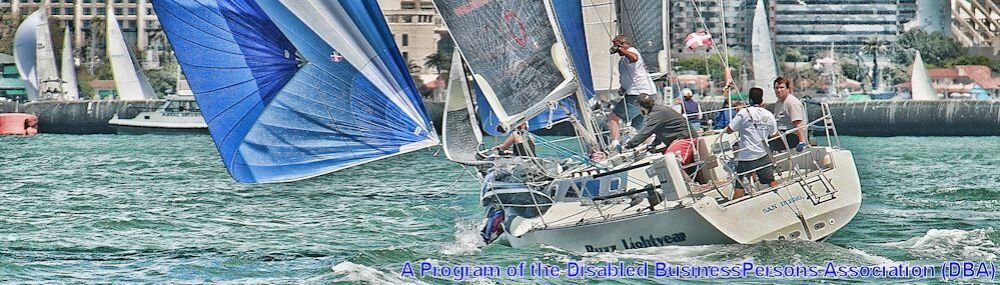
2013 Transpac Team Challenged America, Join Us To Hawaii

Join Us To Hawaii

2013 Transpac Team Challenged America

Aloha,

Challenged America will be in the Transpacific Yacht Race this July 8th, 2013.  Urban Miyares, Co-Founder and David Hopkins, Director of Vessel & Gift Donations for the charitable Challenged America program will be double handed racing on a Tripp 40 sailboat called B’Quest.  What makes their entry special is that Urban Miyares is blind, has Type 1 diabetes (and a host of other medical issues), and David Hopkins has a hearing impairment.  Both of them are disabled veterans … and well seasoned sailboat racers and they intend to win this race.

Why Are They Doing This Race to Hawaii?

Urban and David are dedicated volunteers helping those with physical and hidden impairment through therapeutic sailing and racing programs.  They have literally changed the lives of so many.  Now they are on a quest to bring attention to Challenged America and the needs of the many fellow disabled veterans, as well as to others with disabilities and their loved ones.


A Life of Sailing After Death

Urban Miyares’ story is well-known in the veteran community.  Army infantry platoon Sgt. Miyares was presumed dead during an operation in Viet Nam in 1968 and was placed in a (KIA) body bag when, after two days, a combat medic, assigned to toe-tag the dead soldiers, found him still breathing. From that extraordinary incident and for the next 45 years, Miyares’ has gone on to grow several businesses, become a world class Alpine skier, and has developed his sailing skills to be a competitive offshore racer.

Transpac:  The Famous Race Across the Pacific

The Transpacific Yacht Race (Transpac) is now into its second century.  This legendary race began in 1906 by the request of King David Kalakaua of the Hawaiian Islands.  He felt that this race would strengthen the islands’ economic and cultural ties with the mainland.  Clarence MacFarlane, a racing sailor from Honolulu, initiated the race with other sailors off the coast of San Pedro.  The original starting point was to be San Francisco, but due to the earthquake and fire of 1906, just 27 days prior to the intended starting date, the starting point was changed to Point Fermin in San Pedro, California.  The finish line is off the Diamond Head Lighthouse in Honolulu, Hawaii totaling 2,225 nautical miles.

The challenging race course takes competitors through a myriad of unforeseen conditions: from the cold, wet Northeastern Pacific, through doldrums, enormous seas, abundant squalls and scorching heat, to the blustery trade winds of the Molokai Channel near the finish.  With their start date of July 8th, Urban & David anticipate an arrival in Honolulu of July 19 – 20, with a podium appearance, with you (hopefully) being at the dock in Hawaii for the traditional Aloha Welcome and following ceremonies. With much media coverage assured, you will also be able to follow this race on both the Challenged America website (www.ChallengedAmerica.org) and on the Transpacific Yacht Club’s race website (www.TranspacRace.com).

Come With Us To Hawaii.

You can be a part of the (Sponsorship) crew with David Hopkins and Urban Miyares as they make this most-challenging and demanding crossing to Hawaii.  Your support will help expand the scope of this 36 year old therapeutic Challenged America adaptive sailing program to reach the lives of thousands of kids, adults, and veterans (wounded warriors) with disabilities.

Click on the link bellow  for the information on Sponsoring the Challenged America Program and Urban and David in the 2013 Transpac Race to Hawaii.

Team Challenged America Transpac 2013 Sponsor Program

We eagerly look forward to your support.

Mahalo,

2013 Transpac Team Challenged America Campaign Committee

Tom Jarvis, Cpt. Ken Guyer, John Dodge, Dave Myer, Chris Carstens, Philippe Gadeyne

P.S.  Challenged America is a therapeutic and rehabilitative program of the charitable and educational (501c3) Disabled Businesspersons Association, a volunteer-driven organization enhancing the lives of thousands with disabilities each year.  All support, sponsorship, gifts and donations are tax-deductible to the full extent allowed by the law.  Tax-Exempt #)33-0484461, Disabled Businesspersons Association.

P.S.S.  You can make your donation by sending a check to “Challenged America<” or by PayPal at www.ChallengedAmerica.org, or  talk to someone about Sponsoring Team Challenged America in the 2013 Transpac by either emailing your contact information to Ahoy@ChallengedAmerica.org or call (619) 523-9318.

Make a tax deductible donation, Challenged America needs you

San Diego Entrepreneur Helps Fellow Veterans Through New Initiative at The Hadley School for the Blind

Urban Miyares, president of the San Diego-based Disabled Businesspersons Association, has been named outreach specialist for a new Blinded Veterans Initiative at The Hadley School for the Blind. Miyares is a blinded and multi-disabled veteran who brings more than 40 years experience as an entrepreneur to his new role.

According to the U.S. Department of Veterans Affairs, there are an estimated 158,300 legally blind veterans and 700,000 veterans with low vision. In addition, approximately 7,000 veterans become newly blind or visually impaired each year from non-combat related causes. Compounding the problem is that approximately 70 percent of working age Americans who are blind or visually impaired are unemployed or underemployed.

Read more

Meet Challenged America at the San Diego Sunroad Boat Show

Stop in and meet Challenged America volunteers and participants at the San Diego Sunroad Boat Show this weekend

Did you know? 1 in 5 Americans live with a disability

54 million Americans live with a disability, that’s 19% of the population

  • 5 percent of children 5 to 17 have disabilities.
  • 10 percent of people 18 to 64 have disabilities.
  • 38 percent of adults 65 and older have disabilities.
    Source: 2008 American Community Survey
  • 12.4% are female
  • 11.7% are male
    Source: 2008 American Community Survey
  • 11 million Americans are using or need assistance with everyday activities. These activities include such tasks as getting around inside the home, taking a bath or shower, preparing meals and performing light housework.
  • 3.3 million Americans 15 and older use a wheelchair, another 10 million use a walking aid, such as a cane, crutches or walker.
  • 1.8 million Americans 15 and older who report being unable to see printed words.
  • 1 million Americans 15 and older are unable to hear conversations.
  • 2.5 million Americans 15 and older have difficulty having their speech understood. Of these, 431,000 were unable to have their speech understood.
  • 16.1 million Americans have limitations in cognitive functioning or have a mental or emotional illness that interferes with daily activities. That’s 7 percent of the population 15 and older, including 8 million with one or more problems that interfere with daily activities, such as frequently being depressed or anxious, trouble getting along with others, trouble concentrating and trouble coping with stress.

Read more

What Does it Take to Sail or Race Offshore for a Crew with Disabilities?

When Challenged America first started 35 years ago, the only objective was to race offshore. Easy to do, you may say. But when adding a crew having different types and levels of disabilities, what is traditionally the norm, now becomes quite different, and some may say chaotic and doubtful. To us, it is but another challenge. Hopefully the following will give you a short example of some of the issues confronting any program or skipper having a crew of sailors with disabilities, and a planned offshore adventure ahead.

BOAT: Naval architects tend to first envision a boat’s design from its outside hull shape and form- making sure the hull will be able to accomplish a specific sailing task – and then consider the inside to accommodate all the essentials into the remaining hull cavity, with the new owner being responsible to find the crew capable of meeting to sail and race the boat. However, when Challenged America is able to work with a naval architect to design that “proper yacht” for sailors with disabilities, the designer will need to change focus and work from the ” “inside out.”

As we’ve learned through trial and error – some would say R&D – in real offshore sailing and racing conditions on (donated) vessels not designed with the disabled in mind, we now have to make costly modification and adaptation, or “make do” with what we have, even if it hampers our performance. Safety is paramount; then comes comfort. With the properly designed offshore racing yacht, issues now confronting us will be mitigated or eliminated, safety and performance enhanced, and mainstream sailing achievements reached. Given this, the following is but an introduction to the many issues and concerns Challenged America has previously addressed, and where others should take notice of, when a crew of sailors with disabilities is sailing (mainly) offshore.

DRINKING WATER: Although standard practice allocates ½- to 1-gallon of drinking water per day for each crew member, in most instances, crew members with disabilities require more than the minimum standard allocation to maintain stamina and good health. And when a crew member has a compromised immune system, the water quality should be of higher grade than that of desalinization or water held in a holding tank.

Given this requirement, and water having an 8.345 -pounds per gallon weight, it’s not uncommon that a racing sailboat, on a long voyage with a Challenged America-like crew, such as we’ve done in two Transpac Races to Hawaii, will be burdened with carrying hundreds or more pounds of water (depending on crew size and health/medical requirements), than competitors.

FOOD: Everyone has different culinary and taste preferences, and collecting a crew where all are in-sync to eat anything on the dinner plate is rare. But when you have crew members with disabilities, it’s not only the taste buds that need to be addressed, but health issues and concerns, especially when at sea. Sodium (salt) and sugar consumption, quantities and time of meals, allergic reactions to certain foods, balancing of medications and food consumption, are just a few of the many issues which may arise with some crew members. In most instances, dehydrated or even prepared (frozen) foods, and some snack foods are not an option, and more traditional store-bought foods are required adding extra storage space and weight to the vessel.

GALLEY: We have yet to find a vessel’s galley that is universally designed for sailors with disabilities – from wheelchair users to amputees, those who are blind to others with arthritis, carpal tunnel or using prosthetic. It would take a chapter, if not a book to write about “The Universally Designed Sailor’s Galley,” but I’m sure you can see where the challenge is in today’s sailing vessels are.

Note: In earlier nautical history, ship’s cooks, stewards, carpenters, sail makers and others in the afterguard were often “approved for service” sailors with disabilities. Becoming disabled at sea was not uncommon then; nor is it an uncommon happening today.

SLEEPING: Seasoned sailors are known to be able to sleep anywhere; at any time. And this holds true for many sailors with disabilities. However, for those sailors with spinal cord injury or disease, chronic pain, arthritis, or other medical conditions, sleep accommodations not only need to be medically comfortable but, for some, their sleeping bunk needs to be wider so they can more easily position themselves and move around – to accommodate catheters, infusions sets, and other medical devices, as well as enhance their comfort and be able to change clothes, etc. Curling up and/or crew overlapping their bodies in any available bunk or floor space to sleep, is not a luxury many with disabilities have. Even the standard foam-cushioning may not be appropriate for sleeping accommodations. And the less mobile a sailor is, the closer their bunk will need to be to essentials, such as the head, personal gear, galley, and the companionway to get on-deck.

BATHROOM – HEAD: Where the head is traditionally located on most vessels (in front of or at the mast, unless the vessel is larger with two heads), for sailors with mobility challenges (mainly unable to walk, if they even have limbs), heading to the head in a pounding sea is a challenge, as they slide themselves along the cabin’s flooring to reach their relief area. Going to the bathroom overboard is out of the question, and for the disabled, having a head at mid-ship or at the stern of the boat or near where the bunks are is most important.

Additionally, the head needs to have extra room to accommodate the special needs many have in order to go to the bathroom or take care of personal health and grooming needs, as well as additional safety adaptations – hand rails, even a drop-down bar across the toilet’s seat, preventing someone from falling off the toilet’s seat in rough seas or when an unexpected tack, or gibe occurs is more than a reasonable accommodation … it’s a requirement.

The sink, closet space, doors and drawers, mirror, toilet and sink height, even the size and containment of the trash can, all need to be considered.

ACCESS: Here, again, a chapter can be written on access alone, and expanded to include the access needs of many different types and designs of vessels sailors with disabilities can sail on. From the boarding of a vessel to its cockpit, position of deck hardware and the running rigging to seating accommodations, access the below deck area, and then the cabin itself and being able to easily navigate from bow to stern, both on deck and below, are areas that need serious consideration for the safety and comfort of crew.

Adding and positioning of handrails, possible inclusion of an elevator (hand-driven or motorized) for independent access to/from the cabin (below deck) in any sea condition, slide boards, flashing lights (for the deaf), and other adaptations and modifications may need to be incorporated, depending upon the needs of crew, and type of vessel.

Freeboard height is most important in the design of a proper sailing-racing vessel with crew members having disability, mainly in emergency (M.O.B.) and other access matters.

STORAGE: I’m sure you can envision already the need for additional storage space, and if you’re like most, your vessel shrinks dramatically to the proportion of any planned voyage’s length. And, as you can imagine, just making a size requirement of a pillow case or predetermined size of duffle bag for personal gear, will not work with some sailors having medical needs. And then there may be the additional and unexpected, storage requirements for wheelchairs and prosthetics, in addition to the additional space need for supplies, gear and equipment. Storage space capacity alone may be a determining factor of crew selection, for any overnight and long-distance passage.

MEDICAL: Where most sailors go to sea with minimal medical issues, many sailors with disabilities have secondary medical conditions, both obvious and hidden. Diabetes, epilepsy, chronic pain, high blood pressure, heart or kidney disease, cancer … the list is endless. And with today’s medications and medical devices, this is additional baggage other boats and crews do not (generally) need to accommodate.

Just some of the questions one will need to address are: Where will medications be safely stored for easy access? Do any medications require refrigeration or to be kept cool? Is there a flat work area for crew members to sort and count their pills or set up infusion sets or catheters? How about a place to hang washed catheters for airing and drying? And making special accommodations for disposed needles and other medical appliances needs to be accommodated for the entire crew’s safety and health.

The skipper may also need to carry medications, especially on long voyages/races, that are not the norm, such as pain killers (yes, narcotics in some instances), IV sets, surgical tools, and other medical emergency items … as well as have the knowledge to apply, prescribe and/or use.

The positive side is that, with a crew of sailors having disabilities, the properly prepared vessel just may be the most medically-equipped and medically prepared vessel in any fleet.

TECHNOLOGY: With today’s quickly advancing technology, the scope of what could be covered is extensive. Thus, for the sake of space in this article, and having seen many current advancements in technology either not be applicable to the environment of the open sea or quickly become obsolete before a working prototype is even tested, I’ll leave the technology needs of a proper yacht having sailors with disabilities to another article.

Technology goes in two forms: low-tech and high-tech. And except for communications and navigation, we’ve discovered that in most instances low-tech products tend to have more application, and a much longer shelf-life. What works at the dock often doesn’t work 100 or 1,000 miles offshore.

For example, our cockpit seat for sailors with and without disabilities, now in its 5th generation of development, having thousands of offshore miles of testing, is a proven winner for comfort, safety and performance for any sailor, with our without a disability. Now the redesign of this low-tech, soft-seat needs to be done to make it more cost-effective for commercial use.

Another product many are trying to develop is a talking compass for the blind, or when vision (to see a compass) is poor. The thought and solution by others is sound, but not practical for long-distance offshore use, in our experience. An alternative mode of direction and navigation needs to be developed, rather than a constantly-blasting compass’s degrees audible in the cockpit. We are working on this technology, and will test it when our next offshore racing sailboat is donated.

GEAR/EQUIPMENT: From the proper apparel to the right gear for a crew of “special” sailors is a challenge, with each person so different, even though two sailors may have like disabilities. Giving a crew member a restrictive allowance of only what can fit into a pillow case or a smaller duffle bag, a skipper will quickly discover that some sailors with disabilities require a large suitcase to hold all their apparel, personal gear and cleaning products, medications, medical devices and supplies.

From getting cold quickly (especially when tired), to having clothes easy to remove, for someone who is unable to use their arms or may be missing a hand or two. Apparel is more of personal items, and a complete inventory and evaluation needs to be taken … from head (hat) to toes (socks and footwear).

We often suggest that one prepare themselves for an offshore adventure as if they were going Alpine skiing during the coldest time of the winter, even though we sail mostly in Southern California.

Above is but a sampling, a small sampling, of the many accommodations, adaptations, needs and requirements that need to be addressed or accommodated. From experience, and with Challenged America having done a number of overnight races and two Transpacific Yacht Races to Hawaii, having crew with various disabilities, many being recognized as severely and catastrophically disabled, going to sea with sailors having (obvious or hidden) disabilities takes on a special and unique perspective.

This article may scare you but one only needs to remember that having a disability and having a medical condition or being sick are all entirely different things. And sailors who are in control and able to manage their medical conditions may prove to be the best crew members you have, especially when fatigue or emergencies come into play. It’s the crew member who has a hidden or unexpected medical condition that you are not prepared for, that may be one’s biggest challenge offshore.

If you have a crew member with a disability, or plan on a long voyage with someone having a disability and have questions, don’t hesitate to give us a call. From how to make your vessel accessible, to below deck evaluation, we’ll try to guide you as best we can.

Remember: You and your crew may be able-bodied when you leave the dock, but anything can happen before you return. Being knowledgeable is the key to safe, comfortable, and fast passages.

Thank You,
Urban Miyares
Challenged America, co-founder
Disabled Businesspersons Association, volunteer president

New Testimonial: Karen S.

I came to sail for the first time ever today!  What an incredible experience!  The feeling of controlling that sailboat was amazing!  I feel like it was some type of peaceful work; the entire experience was peaceful and enjoyable, but I also learned that sailing takes a lot of work and concentration.  I like that!  I had never really thought about which way the wind is blowing:  whether it was on my nose, on my right ear, or over my shoulder.  Learning to analyze this, I was able to maneuver the sailboat without continuous “hints” from my “teacher,” John.

John was one of the most gifted teachers I’ve ever met!  He started by explaining and describing every part of the Martin 16, and then as we moved away from the dock, the descriptions became more vivid.  Although I am totally blind, I felt like I was seeing the seals sun bathing on top of the buoys, the birds surrounding a small fishing boat, waiting for something to eat, or the various types of “traffic” that passed us throughout our short voyage.  I learned how to tack, how to move the boat so that it hit the small waves at a 45-degree angle rather than sideways, and how to pull the sail in when it begins to flap in the wind.  John never stopped teaching during those two hours of sailing, and I could have learned from him all day!

From the moment I arrived, I felt very welcome, and enjoyed meeting so many people, who definitely have a passion for sailing.  Thank you for allowing me to participate in this sailing experience and for providing such a gifted volunteer to assist me.  Thank you for keeping this program going, and now that I know what life-changing experiences occur there, I will definitely recommend that my friends and clients come and join the fun and learn how to sail.  I will also spread your mission and goals around in order to find people who will donate to this wonderful organization, so it can continue to thrive.  I am eager to return and sail again–hopefully with John!  Again, thanks just aren’t enough!

Karen S., Challenged America Participant

The 2012 Sailing Calendar

As always, planning a sailing calendar at Challenged America tends to be dependent upon funding and other resources, to include what boats we have, and the volunteers available.  Under consideration for the 2012 calendar are:

  1. San Diego to Puerto Vallarta or Cabo San Lucas ocean race (March, 2012).
  2. Martin 16 (Two-Day) Race to Chula Vista Yacht Club/Marina (April 21/22, 2012).
  3. Monthly or bi-Monthly Martin 16 Race Training and Races.
  4. Local Big Bay Races in “Casual” – the Santana 25.
  5. Newport-Ensenada, Border Run, and other offshore/coastal races.
  6. Multi-day cruise to Catalina.
  7. Class for sailing instructors: “Martin 16 Certification.”
  8. Captain (Basics 101) Training on Grand Banks 42 and Donzi, by The Maritime Institute.
  9. Power Squadron, Offshore Sailing Safety and First Aid Educational Programs.
  10. Sailing Camps for those with disabilities and/or having: Diabetes; Spinal Cord Injury/Disease, Epilepsy, mobility and communications challenges, Learning Disabilities, Developmental Disabilities, and youth with disabilities.
  11. Day-On-The-Big-Bay cruises, whale watching and other educational excursions aboard the motor yacht “Challenged America”- a Grand Banks 42.

Is there another special program you’d like to see and can participate in and help? Let us know.

Challenged America Sailor Chairs National Disabled Sailors Council

Photo: Kevin Wixom trimming the genoa aboard B'Quest I, a Tripp 40 (2005).

Photo: Kevin Wixom trimming the genoa aboard B'Quest I, a Tripp 40 (2005).

Kevin Wixom, Team Challenged America 2005 Transpac crew member and volunteer, has accepted the chair position of the Council for Sailors with Disabilities, US SAILING. Great going Kevin.

The Challenged Galley Chef

Okay, sailors all know that cooking in a kitchen shoreside is a snap. But take a bucking sailboat in a wind-swept sea, and even boiling water and pouring it is a challenge. So you galley-salts, “how” and “what” do you cook when at sea?

For example: I can remember sailing on the east coast years ago in my youth, and one crusty sailing veteran used only coffee (percolator) pots to cook with, on a two-burner stove. He claimed it was the easiest and safest way to cook as, with his half-dozen coffee pots (one reserved exclusively for brewing coffee, and the other for hot water only), he would strum up the greatest soups and stews, pasta dishes and hearty and warm breakfast one could ever imagine. And there was always a hot pot of water on the stove for instant coffee, tea, hot chocolate or bullion.

Do you have any innovative or galley secrets you could share? Let us know. We’re looking for those unique recipes, cooking utensils, and methods of cooking that can be included in the Challenged America newsletter, and later be put into a book, giving you and your boat’s name credit.