Healing Powers of Sailing

The healing power of sailing

One of the greatest joys of sailing is its healing power, its ability to nourish the body and soul. There’s something so soothing about a salty breeze caressing your face and the quietness of the water around you…the feel of control when you’re easing out or trimming the sails…and the way the tiller feels in your hands. Gliding through silky glass waterways, time is not measured by crazy schedules and pressing deadlines, but instead by the rise and fall of each passing crest. You are living in the here and now and enjoying life to the fullest. All feels right with the world.

This may be a routine experience to most sailors, but for some (the wheelchair bound and the terminally ill, for example), the chance to enjoy these simple sailing pleasures are nothing short of life changing.

Leave Your Disabilities at the Door

“I thought sailing was part of my past, something I could no longer do as a result of muscular dystrophy. This program has enabled me to sail again and experience feelings I hadn’t felt for a very long time—feelings like empowerment and freedom. I have learned that you can be blind and still sail as Urban, the founder of the program does, or have a prosthetic leg as Kevin, my sailing companion does. I learned that I could leave my disabilities at the dock, sail in a seven-boat regatta and win!”
-Colin Smith

In 1978, two disabled veterans in wheelchairs were at San Diego’s Mission Bay watching others sail and said, “That looks like fun…and all of them are sitting, too. Now that’s something we should be able to do.” Unable to find a sailing program or school able to accommodate their needs and desires to sail a boat themselves, they purchased a Cal 20 sailboat and invited others, with and without disabilities, to learn how to sail with them.

Thus, Challenged America was born with the goal of introducing adaptive sailing as a new life experience to improve health, build self-confidence, develop new skills and abilities and stimulate independence.

Fast forward to 2012, and Challenged America’s fleet has grown to over a dozen boats (the number varies from month to month, depending on donations and sales of program boats). Today, Challenged America also includes racing and not only attracts the disabled and their loved ones, but also professionals in sports therapy and recreational rehabilitation, sailing instructors, yacht designers, educators, researchers, innovators, engineers and adaptive technology developers from around the world. Best of all, thousands with disabilities, both physical and psychological, have enjoyed a true, often first-time sailing experience with the program.

Read more
2012 ‘Dash” to Chula Vista: Day 2

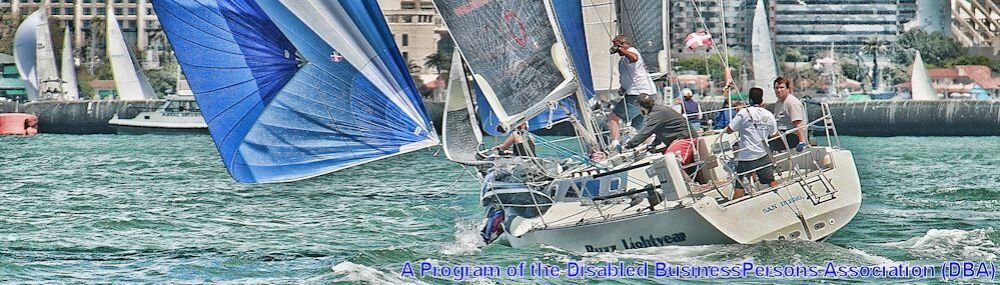
A cool and overcast day with light wind awaited competitors and their companion sailors for the leg back to Harbor Island.

That was not enough to temper the enthusiasm and the second part of the “Dash” to Chula Vista was another success, prompting the Chula Vista Yacht Club race committee to announce that 2012 was officially the first annual “Dash”

Another big thank you to the Chula Vista Yacht Club, the California Yacht Marina and all the volunteers who made the event possible.

And let’s not forget the Venetian Point Loma who supplied delicious pizzas for the after race party

Results coming shortly

KPBS will be airing their interview with Disabled Businesspersons Association (DBA) president urban Miyares

This Friday, February 17, 2012, KPBS will be airing their interview with Disabled Businesspersons Association (DBA) president urban Miyares on their Evening Interview Television Show, at 6:30 p.m., and again on their Saturday morning radio show.

If you miss either of these broadcasts, the interview with Urban will also be on the KBPS website at www.KPBS.org.

Filming of this interview will be conducted at Interwork Institute this Friday at 11 a.m.
Businesspersons Association (DBA) president urban Miyares on their Evening Interview Television Show, at 6:30 p.m., and again on their Saturday morning radio show.

If you miss either of these broadcasts, the interview with Urban will also be on the KBPS website at www.KPBS.org.

Filming of this interview will be conducted at Interwork Institute this Friday at 11 a.m.

“Dash To Chula Vista Race” – April 21-22, 2012

Prepared for a Different Type of Martin 16 Race? Get ready Martin 16 sailors, novice and experienced alike, April 21 & 22 will be the first “Dash To Chula Vista” Race, hosted by Chula Vista Yacht Club.

Starting from our new location on Harbor Island, and (Leg One) finish at the Chula Vista Yacht Club, on Saturday April 21 – where a Welcoming Party will be waiting for you, complete with food, beverage and fun. Then, leave your Martin 16s behind and motor back to the Challenged America dock on Harbor Island…rest at home…and then return, the next day (April 22) to Challenged America and we’ll take you to Chula Vista YC (or you can drive), for the start of Leg Two, from the Chula Vista YC to the finish line at Challenged America on Harbor Island.

A great opportunity to experience a distance race from the North Bay to the South Bay, and learn so much more about sailing and your Martin 16. This will be a fun event for everyone, sailors, family members and friends. Sponsors are welcome and needed.

Notice will be sent to all on the Challenged America Newsletter list, once arrangements have been made…but mark your calendars today for the “Dash To Chula Vista” Race.

San Diego Entrepreneur Helps Fellow Veterans Through New Initiative at The Hadley School for the Blind

Urban Miyares, president of the San Diego-based Disabled Businesspersons Association, has been named outreach specialist for a new Blinded Veterans Initiative at The Hadley School for the Blind. Miyares is a blinded and multi-disabled veteran who brings more than 40 years experience as an entrepreneur to his new role.

According to the U.S. Department of Veterans Affairs, there are an estimated 158,300 legally blind veterans and 700,000 veterans with low vision. In addition, approximately 7,000 veterans become newly blind or visually impaired each year from non-combat related causes. Compounding the problem is that approximately 70 percent of working age Americans who are blind or visually impaired are unemployed or underemployed.

Read more

Meet Challenged America at the San Diego Sunroad Boat Show

Stop in and meet Challenged America volunteers and participants at the San Diego Sunroad Boat Show this weekend

Did you know? 1 in 5 Americans live with a disability

54 million Americans live with a disability, that’s 19% of the population

  • 5 percent of children 5 to 17 have disabilities.
  • 10 percent of people 18 to 64 have disabilities.
  • 38 percent of adults 65 and older have disabilities.
    Source: 2008 American Community Survey
  • 12.4% are female
  • 11.7% are male
    Source: 2008 American Community Survey
  • 11 million Americans are using or need assistance with everyday activities. These activities include such tasks as getting around inside the home, taking a bath or shower, preparing meals and performing light housework.
  • 3.3 million Americans 15 and older use a wheelchair, another 10 million use a walking aid, such as a cane, crutches or walker.
  • 1.8 million Americans 15 and older who report being unable to see printed words.
  • 1 million Americans 15 and older are unable to hear conversations.
  • 2.5 million Americans 15 and older have difficulty having their speech understood. Of these, 431,000 were unable to have their speech understood.
  • 16.1 million Americans have limitations in cognitive functioning or have a mental or emotional illness that interferes with daily activities. That’s 7 percent of the population 15 and older, including 8 million with one or more problems that interfere with daily activities, such as frequently being depressed or anxious, trouble getting along with others, trouble concentrating and trouble coping with stress.

Read more

What Does it Take to Sail or Race Offshore for a Crew with Disabilities?

When Challenged America first started 35 years ago, the only objective was to race offshore. Easy to do, you may say. But when adding a crew having different types and levels of disabilities, what is traditionally the norm, now becomes quite different, and some may say chaotic and doubtful. To us, it is but another challenge. Hopefully the following will give you a short example of some of the issues confronting any program or skipper having a crew of sailors with disabilities, and a planned offshore adventure ahead.

BOAT: Naval architects tend to first envision a boat’s design from its outside hull shape and form- making sure the hull will be able to accomplish a specific sailing task – and then consider the inside to accommodate all the essentials into the remaining hull cavity, with the new owner being responsible to find the crew capable of meeting to sail and race the boat. However, when Challenged America is able to work with a naval architect to design that “proper yacht” for sailors with disabilities, the designer will need to change focus and work from the ” “inside out.”

As we’ve learned through trial and error – some would say R&D – in real offshore sailing and racing conditions on (donated) vessels not designed with the disabled in mind, we now have to make costly modification and adaptation, or “make do” with what we have, even if it hampers our performance. Safety is paramount; then comes comfort. With the properly designed offshore racing yacht, issues now confronting us will be mitigated or eliminated, safety and performance enhanced, and mainstream sailing achievements reached. Given this, the following is but an introduction to the many issues and concerns Challenged America has previously addressed, and where others should take notice of, when a crew of sailors with disabilities is sailing (mainly) offshore.

DRINKING WATER: Although standard practice allocates ½- to 1-gallon of drinking water per day for each crew member, in most instances, crew members with disabilities require more than the minimum standard allocation to maintain stamina and good health. And when a crew member has a compromised immune system, the water quality should be of higher grade than that of desalinization or water held in a holding tank.

Given this requirement, and water having an 8.345 -pounds per gallon weight, it’s not uncommon that a racing sailboat, on a long voyage with a Challenged America-like crew, such as we’ve done in two Transpac Races to Hawaii, will be burdened with carrying hundreds or more pounds of water (depending on crew size and health/medical requirements), than competitors.

FOOD: Everyone has different culinary and taste preferences, and collecting a crew where all are in-sync to eat anything on the dinner plate is rare. But when you have crew members with disabilities, it’s not only the taste buds that need to be addressed, but health issues and concerns, especially when at sea. Sodium (salt) and sugar consumption, quantities and time of meals, allergic reactions to certain foods, balancing of medications and food consumption, are just a few of the many issues which may arise with some crew members. In most instances, dehydrated or even prepared (frozen) foods, and some snack foods are not an option, and more traditional store-bought foods are required adding extra storage space and weight to the vessel.

GALLEY: We have yet to find a vessel’s galley that is universally designed for sailors with disabilities – from wheelchair users to amputees, those who are blind to others with arthritis, carpal tunnel or using prosthetic. It would take a chapter, if not a book to write about “The Universally Designed Sailor’s Galley,” but I’m sure you can see where the challenge is in today’s sailing vessels are.

Note: In earlier nautical history, ship’s cooks, stewards, carpenters, sail makers and others in the afterguard were often “approved for service” sailors with disabilities. Becoming disabled at sea was not uncommon then; nor is it an uncommon happening today.

SLEEPING: Seasoned sailors are known to be able to sleep anywhere; at any time. And this holds true for many sailors with disabilities. However, for those sailors with spinal cord injury or disease, chronic pain, arthritis, or other medical conditions, sleep accommodations not only need to be medically comfortable but, for some, their sleeping bunk needs to be wider so they can more easily position themselves and move around – to accommodate catheters, infusions sets, and other medical devices, as well as enhance their comfort and be able to change clothes, etc. Curling up and/or crew overlapping their bodies in any available bunk or floor space to sleep, is not a luxury many with disabilities have. Even the standard foam-cushioning may not be appropriate for sleeping accommodations. And the less mobile a sailor is, the closer their bunk will need to be to essentials, such as the head, personal gear, galley, and the companionway to get on-deck.

BATHROOM – HEAD: Where the head is traditionally located on most vessels (in front of or at the mast, unless the vessel is larger with two heads), for sailors with mobility challenges (mainly unable to walk, if they even have limbs), heading to the head in a pounding sea is a challenge, as they slide themselves along the cabin’s flooring to reach their relief area. Going to the bathroom overboard is out of the question, and for the disabled, having a head at mid-ship or at the stern of the boat or near where the bunks are is most important.

Additionally, the head needs to have extra room to accommodate the special needs many have in order to go to the bathroom or take care of personal health and grooming needs, as well as additional safety adaptations – hand rails, even a drop-down bar across the toilet’s seat, preventing someone from falling off the toilet’s seat in rough seas or when an unexpected tack, or gibe occurs is more than a reasonable accommodation … it’s a requirement.

The sink, closet space, doors and drawers, mirror, toilet and sink height, even the size and containment of the trash can, all need to be considered.

ACCESS: Here, again, a chapter can be written on access alone, and expanded to include the access needs of many different types and designs of vessels sailors with disabilities can sail on. From the boarding of a vessel to its cockpit, position of deck hardware and the running rigging to seating accommodations, access the below deck area, and then the cabin itself and being able to easily navigate from bow to stern, both on deck and below, are areas that need serious consideration for the safety and comfort of crew.

Adding and positioning of handrails, possible inclusion of an elevator (hand-driven or motorized) for independent access to/from the cabin (below deck) in any sea condition, slide boards, flashing lights (for the deaf), and other adaptations and modifications may need to be incorporated, depending upon the needs of crew, and type of vessel.

Freeboard height is most important in the design of a proper sailing-racing vessel with crew members having disability, mainly in emergency (M.O.B.) and other access matters.

STORAGE: I’m sure you can envision already the need for additional storage space, and if you’re like most, your vessel shrinks dramatically to the proportion of any planned voyage’s length. And, as you can imagine, just making a size requirement of a pillow case or predetermined size of duffle bag for personal gear, will not work with some sailors having medical needs. And then there may be the additional and unexpected, storage requirements for wheelchairs and prosthetics, in addition to the additional space need for supplies, gear and equipment. Storage space capacity alone may be a determining factor of crew selection, for any overnight and long-distance passage.

MEDICAL: Where most sailors go to sea with minimal medical issues, many sailors with disabilities have secondary medical conditions, both obvious and hidden. Diabetes, epilepsy, chronic pain, high blood pressure, heart or kidney disease, cancer … the list is endless. And with today’s medications and medical devices, this is additional baggage other boats and crews do not (generally) need to accommodate.

Just some of the questions one will need to address are: Where will medications be safely stored for easy access? Do any medications require refrigeration or to be kept cool? Is there a flat work area for crew members to sort and count their pills or set up infusion sets or catheters? How about a place to hang washed catheters for airing and drying? And making special accommodations for disposed needles and other medical appliances needs to be accommodated for the entire crew’s safety and health.

The skipper may also need to carry medications, especially on long voyages/races, that are not the norm, such as pain killers (yes, narcotics in some instances), IV sets, surgical tools, and other medical emergency items … as well as have the knowledge to apply, prescribe and/or use.

The positive side is that, with a crew of sailors having disabilities, the properly prepared vessel just may be the most medically-equipped and medically prepared vessel in any fleet.

TECHNOLOGY: With today’s quickly advancing technology, the scope of what could be covered is extensive. Thus, for the sake of space in this article, and having seen many current advancements in technology either not be applicable to the environment of the open sea or quickly become obsolete before a working prototype is even tested, I’ll leave the technology needs of a proper yacht having sailors with disabilities to another article.

Technology goes in two forms: low-tech and high-tech. And except for communications and navigation, we’ve discovered that in most instances low-tech products tend to have more application, and a much longer shelf-life. What works at the dock often doesn’t work 100 or 1,000 miles offshore.

For example, our cockpit seat for sailors with and without disabilities, now in its 5th generation of development, having thousands of offshore miles of testing, is a proven winner for comfort, safety and performance for any sailor, with our without a disability. Now the redesign of this low-tech, soft-seat needs to be done to make it more cost-effective for commercial use.

Another product many are trying to develop is a talking compass for the blind, or when vision (to see a compass) is poor. The thought and solution by others is sound, but not practical for long-distance offshore use, in our experience. An alternative mode of direction and navigation needs to be developed, rather than a constantly-blasting compass’s degrees audible in the cockpit. We are working on this technology, and will test it when our next offshore racing sailboat is donated.

GEAR/EQUIPMENT: From the proper apparel to the right gear for a crew of “special” sailors is a challenge, with each person so different, even though two sailors may have like disabilities. Giving a crew member a restrictive allowance of only what can fit into a pillow case or a smaller duffle bag, a skipper will quickly discover that some sailors with disabilities require a large suitcase to hold all their apparel, personal gear and cleaning products, medications, medical devices and supplies.

From getting cold quickly (especially when tired), to having clothes easy to remove, for someone who is unable to use their arms or may be missing a hand or two. Apparel is more of personal items, and a complete inventory and evaluation needs to be taken … from head (hat) to toes (socks and footwear).

We often suggest that one prepare themselves for an offshore adventure as if they were going Alpine skiing during the coldest time of the winter, even though we sail mostly in Southern California.

Above is but a sampling, a small sampling, of the many accommodations, adaptations, needs and requirements that need to be addressed or accommodated. From experience, and with Challenged America having done a number of overnight races and two Transpacific Yacht Races to Hawaii, having crew with various disabilities, many being recognized as severely and catastrophically disabled, going to sea with sailors having (obvious or hidden) disabilities takes on a special and unique perspective.

This article may scare you but one only needs to remember that having a disability and having a medical condition or being sick are all entirely different things. And sailors who are in control and able to manage their medical conditions may prove to be the best crew members you have, especially when fatigue or emergencies come into play. It’s the crew member who has a hidden or unexpected medical condition that you are not prepared for, that may be one’s biggest challenge offshore.

If you have a crew member with a disability, or plan on a long voyage with someone having a disability and have questions, don’t hesitate to give us a call. From how to make your vessel accessible, to below deck evaluation, we’ll try to guide you as best we can.

Remember: You and your crew may be able-bodied when you leave the dock, but anything can happen before you return. Being knowledgeable is the key to safe, comfortable, and fast passages.

Thank You,
Urban Miyares
Challenged America, co-founder
Disabled Businesspersons Association, volunteer president